- Home
- Skincare Guide
- Retinol Guide
- Retinal vs Retinol
Retinal vs Retinol After 50: Which One Makes More Sense for Mature, Dry, or Sensitive Skin?

✅ The simple answer
After 50, retinal is not automatically better than retinol. Retinal may work faster, but retinol is often easier for dry, mature, or sensitive skin to tolerate consistently. For many women, the better choice is the retinoid that improves fine lines and texture without leaving skin dry, irritated, or depleted.
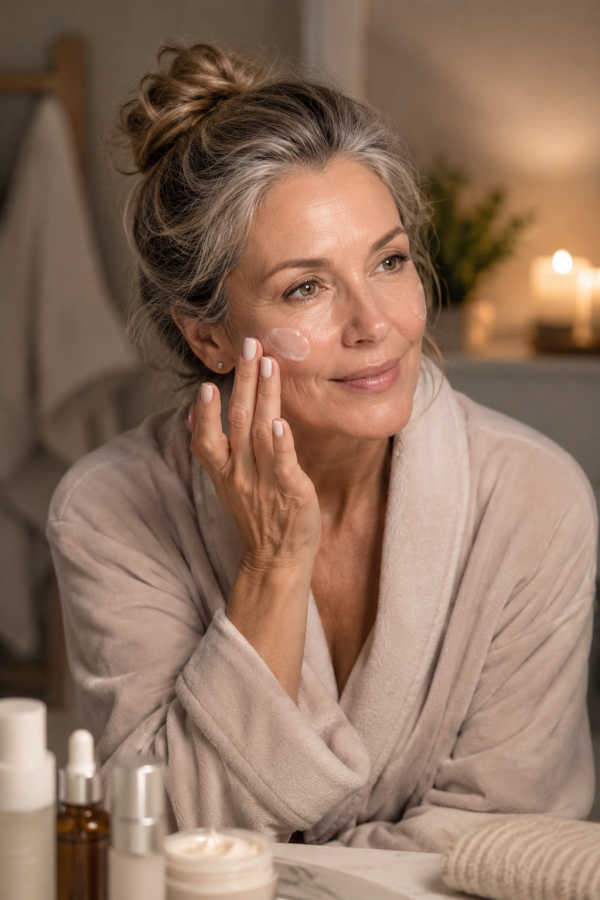 Retinal vs retinol after 50: why stronger is not always better
I've learned over the years that mature skin usually responds best to consistency, hydration, and realistic pacing rather than constantly chasing stronger products.
Personally, I tolerated stronger retinoids for years before dryness and dehydration slowly started catching up with my skin later on. So, I learned that the retinoid that gives the best long-term results is simply the one your skin can comfortably tolerate week after week.
Note: New to retinoids? Start with my Retinol for Wrinkles Over 40 guide first. This page is more about deciding whether to stay with retinol or move up to retinal after 50.
Why stronger is not always better for mature skin
As we get older, skin often becomes thinner, drier, and slower to recover from irritation. That can completely change how the skin reacts to stronger skincare products, including retinoids.
A lot of online skincare advice focuses almost entirely on speed and strength. But mature skin does not always reward aggressive routines the same way younger, oilier skin might. In fact, repeatedly pushing the skin too hard can sometimes leave it looking tighter, shinier, redder, more dehydrated, and even more tired-looking.
For many women over 50, calmer and more consistent skincare often works better long term than constantly trying to move up to the next strongest formula.
Why faster results are not always better
Faster sounds good, especially when a product promises smoother-looking skin, softer lines, or a fresher glow. But after 50, faster is only helpful if your skin can actually handle the product.
I’ve learned this the hard way with strong skincare: if my skin gets too dry, tight, or irritated, I’m not able to use it — and that defeats the whole purpose.
If a stronger retinoid leaves your skin dry, flaky, tight, or irritated, you may end up stopping and starting over and over again. That can make your routine feel frustrating instead of helpful.
The goal is not to use the strongest retinoid possible. The goal is to use one your skin can tolerate often enough to see steady improvement.
Mature skin often needs more support, hydration, and recovery
Mature skin often needs more cushioning, not more punishment. That means enough moisture, enough recovery time, and a routine that does not leave your face feeling raw or overworked.
This is where retinol can still make a lot of sense. And for some women, retinal can work beautifully too — but only when the formula, frequency, and supporting routine are gentle enough.
The best choice is the one that keeps your skin calm enough to stay consistent.
What’s the difference between retinal and retinol?
Both retinal and retinol belong to the retinoid family and are used to help improve things like uneven texture, dullness, fine lines, and overall skin appearance. But they do not behave exactly the same on the skin.
The biggest difference is that retinal works more directly and usually faster, while retinol tends to be slower, gentler, and easier for many people to tolerate.
After 50, that difference is a big deal because mature skin often reacts differently to stronger active ingredients.
Retinol: slower, gentler, and more forgiving
Retinol has been around for years and is still one of the most popular over-the-counter retinoids for a reason. It tends to be easier to ease into slowly, especially for women with dry or sensitive skin.
This is one reason I still think retinol makes sense for many women over 50. Sometimes a gentler product you can use consistently works better long term than a stronger one your skin constantly fights against.
Retinol may also pair better with richer creams and barrier-supporting routines that mature skin often needs.
Retinal: stronger and more direct
Retinal sits one step closer to retinoic acid than retinol, which is why it is often described as stronger or faster-working.
Some women do very well with retinal, especially if their skin already tolerates retinoids comfortably. It may help improve texture and visible aging concerns a bit faster than traditional retinol for some users.
But faster does not always mean better for everyone. Retinal can also increase the chances of dryness, irritation, peeling, or tight shiny skin if the formula or frequency is too aggressive.
Why retinal is often marketed as the “upgrade”
A lot of newer skincare marketing positions retinal as the next-level version of retinol. And technically, there is some truth to that because it works more directly on the skin.
But skincare is not always as simple as choosing the strongest ingredient.
After 50, strength is only one part of the decision. How your skin feels, recovers, and looks the next morning matters just as much.
That’s why I think the better question is not “Which one is strongest?” but “Which one can your skin stays happy with long term?”
When retinol often makes more sense after 50
Retinal gets a lot of attention because it works more directly than retinol. But that does not mean retinol is weak or outdated.
For many women over 50, retinol may be the easier choice to stick with, especially if your skin already feels dry, sensitive, or easily irritated.
If your skin is dry
Dry mature skin usually does not respond well to routines that constantly leave it tight, flaky, or overworked.
This is one reason I still like gentler retinol formulas, especially cream-based ones that pair well with moisturizers and barrier-supporting ingredients.
You do not need your face peeling every week to get benefits from a retinoid.
Note: I also share the gentler retinol and retinal creams I personally think work best for dry mature skin on my Best Retinol Creams for Women Over 40 page.
If your skin is sensitive
Some women can use stronger retinal products without much irritation. Others cannot. And after 50, skin often becomes more reactive than it used to be.
If your skin burns easily, stings with active ingredients, or takes a long time to calm down after irritation, retinol may simply be the easier ingredient to live with consistently.
That matters more than skincare marketing sometimes admits.
If you already use other actives
Many women over 50 are already using exfoliating acids, vitamin C, peptides, brightening ingredients, or treatments for discoloration and texture.
Adding a stronger retinoid on top of all that can sometimes push the skin too far.
But a gentler retinol may fit into your routine without making your skin feel like it has had too much.
If irritation makes you quit
I think this is a bigger issue than many skincare sites talk about.
If a product leaves your skin irritated enough that you stop using it completely, the routine usually falls apart. I’ve found that slower, steadier routines are often easier to stick with long term.
You do not fail skincare by choosing the gentler option.
Sometimes the smarter choice is the one your skin stays happiest with month after month.
When retinal may be worth trying
Retinol is not the only good option after 50. Some women do very well with retinal, especially if their skin already handles retinoids comfortably.
I used stronger retinoids for years without obvious problems. For me, the issue did not really show up until my mid-60s. And it was not redness or peeling. My skin just started looking drier, duller, more dehydrated, and almost a little saggy.
That is what makes this tricky. Retinoid irritation does not always look like a red, flaky face. Sometimes it shows up as skin that just looks tired, dry, or less plump than usual.
If your skin already handles retinoids well
If you already use retinol regularly without much dryness, peeling, or irritation, retinal may be worth exploring.
Some women find it helps improve texture, dullness, and fine lines a little faster than traditional retinol.
But I still would not rush into the strongest formula possible right away. Mature skin can change over time, so what worked beautifully at 50 may not feel the same at 60 or 65.
If you want faster results
One reason some women move to retinal is because they want something stronger than retinol but are not ready for prescription tretinoin.
That can make sense, especially if your skin already tolerates active ingredients fairly well.
Just remember that “faster” sometimes also means drier, tighter, or more dehydrated-looking skin if you overdo it.
Why the formula matters
I honestly think the formula matters just as much as the ingredient itself.
This is one reason I pay more attention now to delivery systems, moisturizing ingredients, and how my skin actually looks the next day — not just the strength percentage on the label.
A well-made retinal cream with moisturizing and barrier-supporting ingredients may feel much gentler than a harsh retinol serum that dries your skin out.
The full product matters, not just the percentage on the label.
If you’re confused by retinol strengths, percentages, or packaging, my OTC Retinol Skin Products page breaks down what actually matters — and what’s mostly marketing.
Creams, serums, and encapsulated formulas
For years, I thought my cream-based retinaldehyde was the better choice because retinal works more directly than regular retinol. It's often marketed as the stronger, faster option — and honestly, I loved it for a long time.
 The retinal I still use occasionally (left) and the encapsulated retinol serum I use more often now (right).
But later on, my skin started changing...
It wasn't dramatic at first.
- It wasn't red.
- It wasn't peeling.
- It didn't look irritated.
- It wasn't sensitive.
It just started looking drier, duller, and more dehydrated.
That's when I realized the product wasn't "bad." It just wasn't something my skin wanted every night anymore.
I still use the cream retinal a few times a month because I do like it. But for regular use, I've switched to an encapsulated retinol serum. Encapsulated retinol releases more gradually, and the formula I use also contains squalane oil and glycolic acid, which my skin seems to tolerate much better.
That experience taught me something important:
The best retinoid isn't always the strongest one. It's the one your skin still looks happy using six months from now.
The real secret: barrier support and consistency
I honestly think this is the part many retinoid articles miss.
For mature skin, the biggest issue is not always whether retinal or retinol is “better.” Sometimes the real issue is whether your skin can keep handling the routine month after month without slowly becoming dry, dull, dehydrated, or stressed.
If your skin suddenly feels tight, reactive, or like nothing works the way it used to, my Skin Support guide can help you sort out what might be throwing it off — before you add more products or push your routine harder.
That is exactly what happened to me later on.
I never had the classic red, peeling retinoid reaction people usually talk about. My skin just slowly started looking more dehydrated, less plump, duller, and almost a little saggy. At first, I did not even realize my routine might be part of the problem because my skin was not obviously irritated.
I think this can happen to more women than people realize, especially as skin changes with age.
What irritation can look like after 50
Retinoid irritation does not always show up as redness and peeling.
Sometimes it looks more like:
- dullness
- tight shiny skin
- dehydration
- makeup sitting badly
- loss of bounce or fullness
- skin that suddenly looks more tired than usual
That is one reason mature skin can be tricky. The signs are not always dramatic.
Why mature skin often needs slower pacing
Skin recovery changes with age. What your skin handled easily at 45 may suddenly feel very different at 60 or 65.
I’ve found that spacing things out more, simplifying my routine, and paying closer attention to hydration made a bigger difference than constantly increasing strength.
Sometimes less really is more with mature skin.
The slow, steady approach that works better for me
These days, I pay much more attention to how my skin looks overall instead of chasing the strongest formula possible.
A few things that help me:
- using retinoids fewer nights per week
- layering moisturizer carefully
- backing off when my skin starts looking depleted
- avoiding too many strong actives at once
- paying attention to dryness, not just redness
I think skin over 50 often looks better when it feels calm and hydrated.
And don't worry, applying a moisturizer after retinoids will not reduce the effectiveness. Just let the product absorb for a few minutes, then apply your moisturizer.
How to decide which one fits your skin best
By this point, you probably already have a sense of which direction your skin is leaning.
If your skin is dry, sensitive, easily dehydrated, or slow to recover, retinol may be the easier option to live with.
If your skin already handles retinoids well and you want somewhat faster results, retinal may be worth trying carefully.
Before you decide, it helps to look at how your skin actually behaves.
Retinol may fit better if you:
You may want to stay with retinol, or start there, if your skin tends to need a gentler approach.
- struggle with dryness or dehydration
- react easily to active ingredients
- already use exfoliating acids or vitamin C
- prefer a slower, steadier approach
- stop using products when irritation starts
Retinol is often the better fit when your skin needs more patience than pressure.
Retinal may fit better if you:
Retinal may make sense if your skin is already comfortable with retinoids and you want a little more strength.
- already tolerate retinoids comfortably
- want somewhat faster results
- do not usually react strongly to active ingredients
- are willing to introduce products slowly and carefully
- pay close attention to hydration and barrier support
Retinal can be a good option, but it still needs to be treated with respect.
Neither choice is automatically better. I think the real goal after 50 is finding the routine your skin can stay happy with — not pushing for the strongest product possible.
How to start either one without upsetting your skin
One of the biggest mistakes I see with retinoids is doing too much too fast.
That usually works against mature skin instead of helping it.
Whether you choose retinal or retinol, I think it makes more sense to start slowly, pay attention to dryness, and give your skin time to adjust.
Start with fewer nights per week
You do not need to use a retinoid every night right away.
For many women over 50, starting with two or three nights a week is plenty at first. That gives your skin time to recover and helps you notice problems before your barrier gets overwhelmed.
Slow progress is still progress.
Pay attention to dryness, not just redness
This was a big lesson for me personally.
I kept waiting for obvious irritation like redness or peeling, but that was not really how my skin reacted. Instead, my skin slowly started looking drier, duller, tighter, and less healthy overall.
That is why I think mature skin needs a little more observation and patience with retinoids.
Be careful combining too many strong actives
Retinoids are not the only products that can stress the skin barrier.
Using strong exfoliating acids, scrubs, peels, and multiple active ingredients all at once can sometimes push mature skin too far, especially when dryness is already an issue.
I’ve been able to use glycolic acid and retinol in the same overall routine, but I’m more careful now about spacing them out and watching how my skin responds.
If you’re trying to combine stronger ingredients, my page on using glycolic and lactic acid together explains how to space active ingredients more carefully so your skin barrier stays happier.
Sometimes simplifying the routine helps more than adding another product.
Back off before your skin gets overwhelmed
I think this is where many women get into trouble.
If your skin suddenly starts looking depleted, shiny, papery, extra dry, or tired, it may be time to slow down for a while instead of pushing harder.
Your skin usually tells you when it needs more recovery time. The hard part is learning to listen before things get worse.
Is retinal stronger than retinol?
Is retinal stronger than retinol?
Yes. Retinal is generally considered stronger because it works more directly in the skin. But stronger is not always better if your skin becomes dry, tight, irritated, or hard to keep comfortable.
Is retinol gentler than retinal?
Is retinol gentler than retinal?
For many people, yes. Retinol is usually slower and more forgiving, which can make it a better fit for dry or sensitive mature skin.
Can retinal dry out mature skin?
Can retinal dry out mature skin?
Yes, it can. Some women notice redness or peeling, but others may only see dryness, dullness, tightness, or a less plump look. That still matters, even if your face does not look obviously irritated.
Should I use retinal every night?
Should I use retinal every night?
Not at first. Mature skin often does better when you start a few nights a week and slowly adjust based on how your skin looks and feels.
Can I switch back to retinol after using retinal?
Can I switch back to retinol after using retinal?
Yes. Switching back to retinol is not a step backward. If your skin looks calmer, softer, or more hydrated with retinol, that may be the better choice for you.
Do I still need sunscreen?
Do I still need sunscreen?
Yes. Retinoids can make skin more sun-sensitive, and daily sunscreen helps protect the progress you are trying to make. Retinoids make sunscreen even more important because UV exposure can work against the progress you’re trying to make.
Takeaway
Retinal and retinol can both be useful after 50. The best choice depends on how your skin responds, not which ingredient sounds more advanced.
For some women, retinal may be worth trying. For others, retinol is the better fit because it is easier to use without dryness, tightness, or that dull, depleted look.
I think skin over 50 often looks better when it feels calm, nourished, and not pushed to its limit all the time. Stronger is not always smarter. Sometimes the real win is finding what your skin can happily live with.
Have a question or want to share your experience?

I'd love to hear from you! Visit my Questions & Comments page to ask a question, share a tip, or tell me what's worked for you.
Stay Connected with Me
Want to see what I’m up to? I’ll keep you posted on new products I’m trying, little tricks I’ve discovered, new finds, and a few personal updates too.

About the Author:
Linda Robison is a Certified Facial Fitness Specialist and founder of Anti-Aging Beauty Zone, where she shares practical tips, products, techniques, and at-home options for women over 40. She personally tests many of the methods she writes about.
Experience: Linda spent nearly 15 years as an Anti-Aging Health Advisor at the Life Extension Foundation and has over 30 years of experience testing facial anti-aging techniques, including training in Carolyn’s Facial Fitness. Her work has been featured in GB News and Beauty Box Magazine. You can view her background on LinkedIn and follow her on Pinterest.
Found this helpful? Tap the ♡ in the bottom right corner.
FOLLOW OR SAVE

Stay Connected with Me
Want to see what I’m up to? I’ll keep you posted on new products I’m trying, little tricks I’ve discovered, new finds, and a few personal updates too.
Affiliate disclosure: As an Amazon Associate and affiliate for other brands, I may earn a commission from qualifying purchases, at no extra cost to you. [Read Disclosure.] A quick note: I create the content on this site and sometimes use AI tools for writing and images. I review everything for accuracy, and my before-and-after photos are my own.

Anti-Aging Beauty Zone (ABZ): Small Changes, Big Results!
ALL CONTENT COPYRIGHT© 2013-
ALL RIGHTS RESERVED REGARDLESS OF LINKS OR ATTRIBUTIONS
ALL CONTENT COPYRIGHT© 2013-
ALL RIGHTS RESERVED
REGARDLESS OF LINKS OR ATTRIBUTIONS