- Home
- Eye Makeup
- Eyeliner
- Eyeliner Colors
What’s the Best Eyeliner Color for Older Women?

✅ Quick answer
Deep brown is often the easiest eyeliner color to try first on mature eyes, but it is not always the most flattering for everyone. Charcoal can be a good middle ground if brown looks too warm or black feels too strong. Below, I compare the shades and show what worked best on my own eyes.
 I’m wearing navy eyeliner on my right eye (your left) and plum on my left. On me, the plum looks less defined and brings out a bit more redness, while the navy gives clearer definition.
Closer comparison: I’ll show you brown vs. hunter green farther down the page. Yes, while hunter green isn’t an obvious choice, it works surprisingly well on my mature eyes.
Black eyeliner often gets blamed for looking too harsh on mature eyes. Sometimes it does—but simply switching to brown is not always the answer.
I found that out on my own eyes. I have a little redness and discoloration around the inner corners, which I usually soften with concealer. Some brown eyeliners leave me looking washed out, while warmer browns and plum shades (as you can see in the picture above) can bring out the reddish tones. Charcoal can work, but on me it needs to be a deep, richly pigmented gray or it doesn’t give my eyes enough definition.
For me, a thin line of black or deep hunter green works best. Black gives stronger definition, but on tired-eye days it can also make the tiredness stand out. Hunter green gives me the depth I need without looking quite as heavy.
That does not mean hunter green is best for everyone. The right color depends on your natural coloring, any redness around your eyes, and how much contrast your eyes need.
Start with the amount of definition your eyes need
Before choosing a color, think about how much definition your eyes actually need.
Some women look best with a soft brown or charcoal line that gently frames the lashes. Others need a little more contrast or their eyes seem to disappear, especially if their lashes have become lighter or the skin around the eyes has less natural color than it used to.
That is why “just switch to brown” is not always useful advice. A color can be softer than black but still be too light to do anything for your eyes.
Start by asking yourself one simple question:
Do my eyes need softer definition, or do they need stronger definition without the heaviness of black?
If black looks too strong but brown seems to disappear, you may do better with a deeper shade such as navy, hunter green, black-brown, or a very thin application of black. If black still looks good but feels heavy, changing the thickness or placement may help more than changing the color.
Deep brown is the usual first choice—but it does not work for everyone
Deep brown is often recommended as the safest alternative to black because it gives the eyes definition with less contrast. For many women, it is an easy everyday choice.
But softer does not always mean better.
If the brown is too light, your eyes may seem to disappear instead of looking more defined. Warmer browns can also bring out reddish tones or discoloration around the eyes, especially if you already have some redness near the lids or inner corners.
That is what happens to me. Lighter browns leave me looking washed out, while warmer browns can make the reddish tones around my eyes more noticeable.
 Hunter green is on my right eye (your left), and brown is on my left eye. The brown looks less defined and brings out more redness, while hunter green gives my eyes more depth without looking as heavy as black.
A deeper espresso or black-brown may work better than a medium brown if you still need contrast. But if brown continues to look flat or too warm, it may simply not be your best eyeliner color—and that is okay.
Brown vs. black eyeliner for mature eyes
If you're deciding between brown and black eyeliner, brown usually gives a softer look, while black gives stronger definition. But softer isn't automatically better on mature eyes. If brown makes your eyes look washed out or seems to disappear, a thin black line may actually be more flattering.
The amount you use matters just as much as the color. Black can look softer when it is kept close to the upper lashes, while even brown can look heavy if too much is applied.
Personally, for my eyes, black gives me more definition than brown, although I use less of it when my eyes look tired.
The next step is to choose a shade based on the effect you want, rather than assuming brown is the answer for everyone.
Choose a shade by the effect you want
Once you know how much definition your eyes need, the next step is choosing the effect you want the color to create. Some shades soften, some brighten, and some add warmth.
Charcoal for cooler, softer definition
Charcoal can be a good choice if brown looks too warm against your skin. It gives a softer effect than black without adding reddish tones.
The downside is that some charcoal shades are so soft they do not give enough contrast. If your eyes need stronger definition, look for a deep charcoal rather than a pale gray.
Navy for a fresher-looking effect
Deep navy can add definition while helping the whites of the eyes appear clearer. Choose a dark ink blue or midnight navy rather than a bright blue.
It can be a useful choice when brown looks flat but black feels too strong.
Plum for gentle warmth
Plum and aubergine can bring out green or hazel eyes and add warmth without the sharpness of black.
But plum contains reddish-purple tones, so it may not be the best choice if you already notice redness or discoloration around your eyes. On me, plum tends to emphasize those tones rather than make my eyes look clearer.
Hunter green for depth without heavy contrast
A deep hunter green can work well when brown does not give enough definition but black looks too heavy.
This is the shade I often use on tired-eye days. It gives my eyes more depth without looking obviously green or creating quite as much contrast as black.
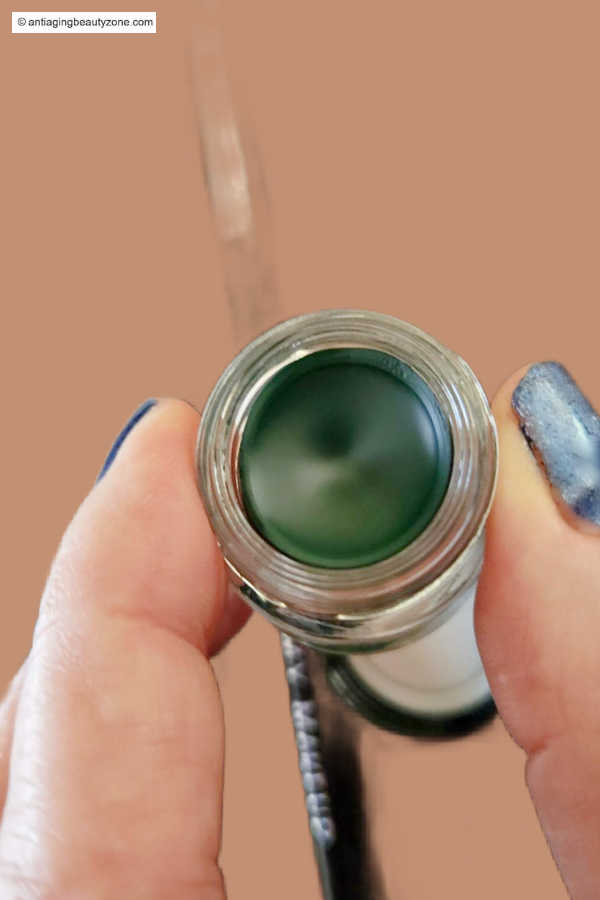 The liner gel looks green in the pot, but once applied it reads more like a softer, deeper alternative to black.
Want to try the one I use? I wear Mommy Makeup Stay Put Gel Eyeliner in Hunter because it gives me more definition than brown without looking as heavy as black.
[See the hunter green gel eyeliner here.]
Curious how to apply it? Take a look at my Hunter Green Eyeliner for Mature Eyes page, where I show how I use it.
When redness changes the usual color advice
As we get older, the skin around the eyes gets thinner, so redness and discoloration can become more noticeable. I see this on myself, especially around the inner corners of my eyes.
Warm shades like brown, bronze, burgundy, or plum can sometimes make that redness stand out even more.
As you can see in the photo above, the brown looks softer on me, but it also brings out more redness. The hunter green gives me more definition without looking as heavy as black.
If that happens to you too, try a cooler or deeper shade like charcoal, navy, hunter green, black-brown, or even a thin line of black.
What eyeliner color works best with your eye color?
Personally, I don’t think your eyeliner color has to match your eye color. Eye color can help narrow down your choices, but I’d pay more attention to which shade gives your eyes the best definition.
Brown eyes: Deep navy, hunter green, plum, brown, and black can all work well. If warm brown makes the area around your eyes look red or tired, try a cooler shade like navy or hunter green.
Green eyes: Plum and aubergine can bring out green eyes, but they may also bring out redness around the lids. Deep brown, charcoal, or hunter green may be better if that happens.
Blue eyes: Brown and bronze can add warmth, while charcoal or navy gives a cooler look. If softer shades do not give you enough definition, a thin black or black-brown line can still work.
Placement can change how a color looks
The same eyeliner color can look soft in one spot and much heavier in another. Before ruling out a shade completely, consider where you are placing it and how much of it is visible.
Color is only part of choosing the right eyeliner. The formula matters too, especially if your liner skips, smudges, transfers, or tugs on the lid. See how to choose the right eyeliner type for mature eyes.
A bold, dark color can work very well on the upper waterline because most of the color sits inside the lash line. It adds depth at the roots of the lashes without creating a thick stripe across the lid.
The lower lash line is different. That is often where dark color can make mature eyes look smaller, heavier, or more tired—especially when it goes all the way across. Even brown or charcoal can feel like too much if the line is thick, very dark, or carried too close to the inner corner.
For many mature eyes, a simple starting point is:
- Use your deepest shade on the upper waterline or close to the upper lashes.
- Keep lower liner lighter, softer, and thinner.
- Keep lower liner on the outer third when taking it all the way across looks heavy.
- Avoid carrying a dark shade into the inner lower corner.
- Try nude or soft beige on the lower waterline when you want the eyes to look more open.
This is also why I don't believe black eyeliner needs to be replaced. A dark shade pressed into the upper waterline can look softer and more flattering than a lighter color drawn heavily beneath the eye.
Here, we are only looking at how placement affects your color choice.
Need more help with placement?
Check out my Eyeliner Makeup for Older Women page for simple tips on the upper and lower lash lines.
Black can still work on mature eyes
Black eyeliner is not automatically too harsh for older women. I’m over 65, and I still wear black eyeliner when I want stronger definition. Sometimes it is still the best choice, especially when your eyes need more contrast than brown, charcoal, or plum can provide.
The key is usually how much black you use and where you place it.
A thin line pressed close to the upper lashes can make the eyes look sharper and more defined without taking over the whole eye area. Tightlining the upper waterline can work especially well because the color sits at the base of the lashes instead of looking like a heavy stripe across the lid.
Black tends to look harder when it is thick, sharply drawn, or carried heavily underneath the eye. On days when my eyes already look tired, too much black can make both the definition and the tiredness stand out.
For a softer effect, try:
- Keeping black on the upper eye only.
- Pressing or smudging it into the lash line instead of drawing a thick line above it.
- Applying less toward the inner corner.
- Softening the edge slightly rather than leaving it crisp.
- Using black mascara with a softer eyeliner shade.
Once you choose your color, see tips on how to apply eyeliner on mature eyes so the line looks defined without becoming thick or heavy.
You don't have to stop wearing black because of your age. You may simply need less of it, or a different placement, than you used when you were younger.
Quick eyeliner color comparison
Brown and charcoal are two common alternatives to black for mature eyes because they usually look softer. I compared both on my own eyes and found that brown adds more warmth, while charcoal gives a cooler, softer look—but neither gives me quite as much definition as black or hunter green.
Here is a simple way to narrow down your choices based on the effect you want.
| If you want… | Try… | Keep in mind |
|---|---|---|
| Softer everyday definition | Deep brown or espresso | May look flat or bring out redness on some complexions. |
| Cooler softness | Deep charcoal | Can disappear if your eyes need more contrast. |
| A fresher, clearer look | Deep navy | Choose a deep navy rather than a bright blue. |
| Gentle warmth | Plum or aubergine | May emphasize redness around the eyes. |
| More depth without heavy black | Hunter green | A good option when brown feels too soft. |
| Stronger definition | Thin black or black-brown | Usually looks best kept close to the upper lashes. |
The best eyeliner color isn’t always the one that matches your eye color. It’s the one that gives you enough definition without making redness or tired-looking eyes stand out more.
Brown vs. charcoal eyeliner for mature eyes
I’ve personally wondered whether charcoal gray might be a good middle ground between brown and black. Brown can sometimes look too light on me or bring out the reddish discoloration I have around my eyes and lids, while black can look a little too strong on days when my eyes are especially tired.
A dark charcoal gray gives a cooler, softer look without the warmth of brown or the stronger contrast of black. It still gives me definition, although I need a fairly deep charcoal gray or it can disappear on my eyes.
So the shade is only part of it—the depth of the color and the formula matter too. I do better with a rich, deeply pigmented charcoal than a soft gray that fades away on my eyes.
How to choose your best eyeliner color
The easiest way to decide is to apply one shade at a time, look at your whole eye area in natural light, and ask yourself:
- Do my eyes look clearer and more defined?
- Does the color make redness or discoloration stand out?
- Do my eyes look brighter or more tired?
- Is the eyeliner framing my eyes—or taking over?
There is no rule that every older woman should switch to brown or stop wearing black. The right color is the one that gives your eyes enough definition without overpowering them.
Not sure where to place the liner once you choose a shade? Check out my Eyeliner Makeup for Older Women page for simple upper- and lower-lid placement tips.
And if hunter green sounds like it might be a better fit, take a look at my Hunter Green Eyeliner for Mature Eyes page. I show the color on my own eyes, explain why I prefer it over brown, and share how I apply it.
Takeaway
The best eyeliner color for older women is not always brown, and black is not automatically wrong. Once you know which color you want, my best eyeliners for aging eyes page can help you choose a formula that glides without tugging.
What matters most is how the shade looks with your natural coloring, whether it brings out redness, and whether it gives your eyes enough definition without making them look heavier or more tired.
For me, a thin line of black or deep hunter green works better than brown, plum, or charcoal.
Your best shade may be different, but what matters is how your whole eye area looks—not just the eyeliner color itself.
Start with one small change and see how it looks in natural light. The right eyeliner should help your eyes stand out—not the eyeliner itself.
For more simple ways to define mature eyes, visit my Eye Makeup Tips for Older Women page.
Stay Connected with Me
Want to see what I’m up to? I’ll keep you posted on new products I’m trying, little tricks I’ve discovered, new finds, and a few personal updates too.

About the Author:
Linda Robison is a Certified Facial Fitness Specialist and founder of Anti-Aging Beauty Zone, where she shares practical tips, products, techniques, and at-home options for women over 40. She personally tests many of the methods she writes about.
Experience: Linda spent nearly 15 years as an Anti-Aging Health Advisor at the Life Extension Foundation and has over 30 years of experience testing facial anti-aging techniques, including training in Carolyn’s Facial Fitness. Her work has been featured in GB News and Beauty Box Magazine. You can view her background on LinkedIn and follow her on Pinterest.
Found this helpful? Tap the ♡ in the bottom right corner.
FOLLOW OR SAVE

Stay Connected with Me
Want to see what I’m up to? I’ll keep you posted on new products I’m trying, little tricks I’ve discovered, new finds, and a few personal updates too.
Affiliate disclosure: As an Amazon Associate and affiliate for other brands, I may earn a commission from qualifying purchases, at no extra cost to you. [Read Disclosure.] A quick note: I create the content on this site and sometimes use AI tools for writing and images. I review everything for accuracy, and my before-and-after photos are my own.

Anti-Aging Beauty Zone (ABZ): Small Changes, Big Results!
ALL CONTENT COPYRIGHT© 2013-
ALL RIGHTS RESERVED REGARDLESS OF LINKS OR ATTRIBUTIONS
ALL CONTENT COPYRIGHT© 2013-
ALL RIGHTS RESERVED
REGARDLESS OF LINKS OR ATTRIBUTIONS