- Home
- Skincare Guide
- How Sunscreen Works
- Powder vs Tinted
Powder vs Tinted Sunscreen: Can Powder Work on Its Own and Which Feels Better in Heat?

Powder and tinted sunscreens don’t wear the same—especially in heat. One can leave your skin looking shiny and heavy, while the other feels light and easy to reapply.
I didn’t start comparing them because of ingredients or labels, but because of how different they felt on my skin day to day. One felt light and easy… the other could get shiny and greasy fast.
Most advice says brush-on powder sunscreen is just for touch-ups—but that’s not always the full picture.
 This is how tinted sunscreen looks on my skin in natural light—smooth and even, but on hot days, that glow can turn a bit shiny.
Powder vs tinted sunscreen: what’s the difference—and how do they feel and wear on your face?
Powder sunscreen (often called a brush-on sunscreen) feels lightweight, matte, and easy to reapply—especially over makeup.
Tinted sunscreen feels creamier, more hydrating, and smoother, but can look shinier or feel heavier in heat or on oily skin.
You’ll often read that powder sunscreen is only for touch-ups—but some newer, high-SPF brush-on formulas are designed to be worn on their own.
Most guides say powder sunscreen is for later in the day, while tinted sunscreen is your base. But in real life, how they feel and wear matters just as much.
Which feels better on hot days?
One of the biggest differences shows up in heat.
On hot days, especially if you’re outside or running around, tinted sunscreen can start to feel heavier on the skin.
Powder sunscreen feels completely different. It’s light, dry, and almost disappears into your skin. Instead of adding shine, it can actually help tone it down, which is why I tend to reach for it more in the summer or anytime I know I’ll be active.
Another big difference is how each one holds up throughout the day.
Here’s what that difference can look like on my skin:
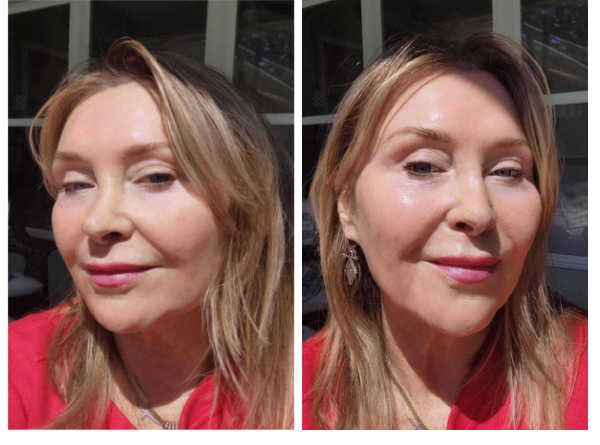 Brush-on powder (left) vs tinted cream (right). When my skin gets shiny, the powder is so much easier to refresh without that greasy look.
With tinted sunscreen, once it starts to wear down or look shiny, it’s not always easy to fix—especially if you’re wearing makeup. Powder sunscreen, on the other hand, is much easier to refresh. You can quickly brush it on without disturbing what you already have on your face.
I noticed it most when I was out all day in the heat—my face would get greasy and shiny, and I didn’t even want to reapply.
That’s when powder sunscreen started to feel easier to keep up with. On cooler days, or when my skin feels dry, tinted sunscreen feels smoother and more hydrating.
Which is easier to reapply over makeup?
You really notice the difference when you're trying to add more sunscreen over makeup without messing everything up. We all know we’re supposed to—but once your makeup is on, it’s not always that simple.
Tinted sunscreen can be trickier here. Since it’s cream-based, layering it over foundation or concealer can feel heavy and sometimes shift what you already have on.
Brush-on powder sunscreen is much easier in this situation. You can brush it on easily, it blends right in, and it doesn’t add extra weight or shine. But it only works well if you apply enough.
For me, this is one of the biggest reasons I keep both on hand—on hot, humid days when my skin feels greasy or sweaty, I’ll use a brush-on sunscreen on its own and just reapply it. On cooler days, or when my skin feels dry, I reach for a cream or tinted sunscreen instead.
Why you’ll hear different things about powder sunscreen
If you’ve been looking into powder sunscreen, you’ve probably noticed something confusing.
Some sources say it should only be used as a touch-up and not on its own. Others—especially certain brands—say it can be worn alone as your main sunscreen.
Both of those things can be true, depending on the situation.
Powder sunscreens use the same types of mineral filters found in many traditional sunscreens. So in terms of ingredients, they can provide protection.
If you're someone who pays close attention to ingredients or prefers simpler formulas, you might also want to explore chemical-free sunscreen options for your face, which breaks down safer choices for everyday use.
The difference comes down to how they’re applied.
To reach the full SPF on the label, you need to apply enough product and cover your skin evenly. That’s easier to do with a cream, and harder to judge with a powder.
It’s easier to under-apply powder compared to creams, which is why general advice still leans toward using it as a second layer.
At the same time, some powder sunscreens are designed to be worn on their own and can be used that way if you apply them thoroughly.
So it’s not that powder sunscreen is “just a touch-up”—it’s how you apply it matters more. If you’re wondering how this affects long-term skin health, here’s a closer look at whether sunscreen prevents aging.
When comparing powder vs tinted sunscreen, this is the question that comes up most:
Does powder sunscreen really work?
Powder sunscreen can work on its own if applied thoroughly and evenly, but it’s more technique-dependent than creams. Some newer brush-on formulas are designed for daily use and include mineral filters and iron oxides for added protection—but a light dusting won’t provide full SPF coverage.
To better understand how well a sunscreen protects your skin beyond SPF, it helps to know what PA ratings mean in sunscreen and how they relate to UVA protection.
But even with all that, this is where things can start to feel confusing—and where a lot of advice gets oversimplified.
You’ll still read that powder sunscreen is only for touch-ups. And for a long time, that made sense. But some newer brush-on formulas are designed to be worn on their own.
The one I use—Colorescience’s brush-on sunscreen—includes mineral filters and iron oxides, so it helps protect against both UV and visible light. I use it on bare skin or over makeup depending on the day, and it’s designed for daily wear.
Example of a full-use powder:
The brush-on sunscreen I use is SPF 50, includes iron oxides for visible light protection, and is designed to be worn alone or over makeup when applied thoroughly.
Why application matters more than the formula
Here’s the part that really matters for effective SPF protection: application.
To get the SPF on the label, you need enough product and even coverage. That’s easy to see with a cream—and much easier to underestimate with a brush.
And once you’ve chosen the type of sunscreen you’re using, it also helps to know when to apply sunscreen in your skincare routine so you actually get that full protection.
That’s where most people run into trouble. That’s why it helps to follow the application directions—especially with brush-on formulas, where it’s easy to underestimate how much you need.
Some newer powders suggest building it up in layers or applying for a full minute to get proper coverage—and that makes a noticeable difference.
So it’s not that powder sunscreen doesn’t work—it’s that how you apply it matters more.
A quick dusting usually isn’t enough. But when you apply it thoroughly and evenly, it can perform very differently than people expect.
So while general guidance still says “touch-up only,” some high-SPF, iron-oxide powder sunscreens can work as your main sunscreen—if you apply them thoroughly and evenly.
That’s why you’ll see two different recommendations:
- general guidance → use it as a touch-up
- newer formulas → can work on their own when applied correctly
And honestly, both can be true.
When I use powder vs tinted sunscreen
For me, this really comes down to how my skin feels that day and what I have going on.
If it’s hot, humid, or I know I’ll be outside for a while, I almost always reach for powder sunscreen. My skin tends to get shiny in the heat, and the powder helps keep things looking more matte.
It’s also just easier to deal with throughout the day—I can reapply it quickly without thinking about it or worrying about messing up my makeup.
On the other hand, when my skin feels dry or it’s cooler out, tinted sunscreen feels a lot better. It goes on smoother, gives a more even look, and doesn’t leave my skin feeling dry or flat the way powder sometimes can.
I also tend to use tinted sunscreen more when I’m not planning to reapply as often or when I want that slightly more polished, even finish without needing extra makeup.
Instead of thinking of powder vs tinted sunscreen as one being better than the other, I think of them as two options depending on the situation.
For me, it’s simple:
- hot or makeup days → powder
- cooler days or when my skin feels dry → tinted
Having both just makes it easier to adjust without overthinking it.
Which one should you choose?
If you’re trying to decide between powder vs tinted sunscreen, it really comes down to how you want your skin to look and feel during the day.
If you prefer something lightweight, more matte, and easy to reapply—especially over makeup—powder sunscreen is usually the better fit. It’s quick, low-maintenance, and works well when you’re out and about or dealing with heat and shine.
If your skin tends to feel dry or you like a smoother, more even finish, tinted sunscreen may feel more comfortable. It can give you that soft coverage while still acting as your base layer in the morning.
For a lot of people, it’s not really about choosing one over the other. It’s about using each one when it makes sense.
If you want something simple to follow:
- choose powder sunscreen if you want something light, matte, and easy to reapply
- choose tinted sunscreen if you want hydration and a more even-looking finish
- use both if you want the flexibility to adjust throughout the day
Once you get used to how each one feels, it becomes pretty easy to know which one to reach for.
Takeaway
For me, it really comes down to this—on hot days I reach for powder because it’s lightweight and easy to reapply, and when my skin feels dry, I use a tinted cream sunscreen because it’s more hydrating. Both have a place.
Stay Connected with Me
Want to see what I’m up to? I’ll keep you posted on new products I’m trying, little tricks I’ve discovered, new finds, and a few personal updates too.

About the Author:
Linda Robison is a Certified Facial Fitness Specialist and founder of Anti-Aging Beauty Zone, where she shares practical tips, products, techniques, and at-home options for women over 40. She personally tests many of the methods she writes about.
Experience: Linda spent nearly 15 years as an Anti-Aging Health Advisor at the Life Extension Foundation and has over 30 years of experience testing facial anti-aging techniques, including training in Carolyn’s Facial Fitness. Her work has been featured in GB News and Beauty Box Magazine. You can view her background on LinkedIn and follow her on Pinterest.
Found this helpful? Tap the ♡ in the bottom right corner.
FOLLOW OR SAVE

Stay Connected with Me
Want to see what I’m up to? I’ll keep you posted on new products I’m trying, little tricks I’ve discovered, new finds, and a few personal updates too.
Affiliate disclosure: As an Amazon Associate and affiliate for other brands, I may earn a commission from qualifying purchases, at no extra cost to you. [Read Disclosure.] A quick note: I create the content on this site and sometimes use AI tools for writing and images. I review everything for accuracy, and my before-and-after photos are my own.
Anti-Aging Beauty Zone (ABZ): Small Changes, Big Results!
ALL CONTENT COPYRIGHT© 2013-
ALL RIGHTS RESERVED REGARDLESS OF LINKS OR ATTRIBUTIONS
ALL CONTENT COPYRIGHT© 2013-
ALL RIGHTS RESERVED
REGARDLESS OF LINKS OR ATTRIBUTIONS