- Home
- Lower Face
- Buccal Fat Removal for Jowls
Buccal Fat Removal vs. Jowls: Why It’s Not the Same Thing

✅ Quick answer
Buccal fat removal can slim fullness in the lower cheeks, but it does not lift loose skin or directly correct true jowls.
Buccal fat sits higher on the face, between the cheekbones and jawline. Jowls form lower down, along the jaw, as skin and supporting facial tissues begin to loosen.
After 40, what looks like excess cheek fat may actually be a mix of shifting facial volume, looser skin, and changes in facial support.
Not sure which type of fullness you have? See my own before-and-after photos showing why lower-face fullness can be difficult to identify before assuming buccal fat should be removed.
After 40, this distinction matters even more. Removing cheek fat from a face that is already losing natural volume may make hollows, shadows, or sagging look more noticeable rather than improving the jawline.
The confusing part is that both problems can make the lower face look heavier, but they usually need very different solutions.
- Fullness beneath the cheekbones: Buccal fat may be contributing.
- Sagging along the jawline: This is more likely true jowling or loose skin.
- Changes across the cheeks, jaw, and neck: This may be part of broader lower-face aging rather than one isolated fat pocket.
If your main concern is looseness along the jawline, start with my guide to non-surgical ways to smooth out jowls before considering cheek-fat removal.
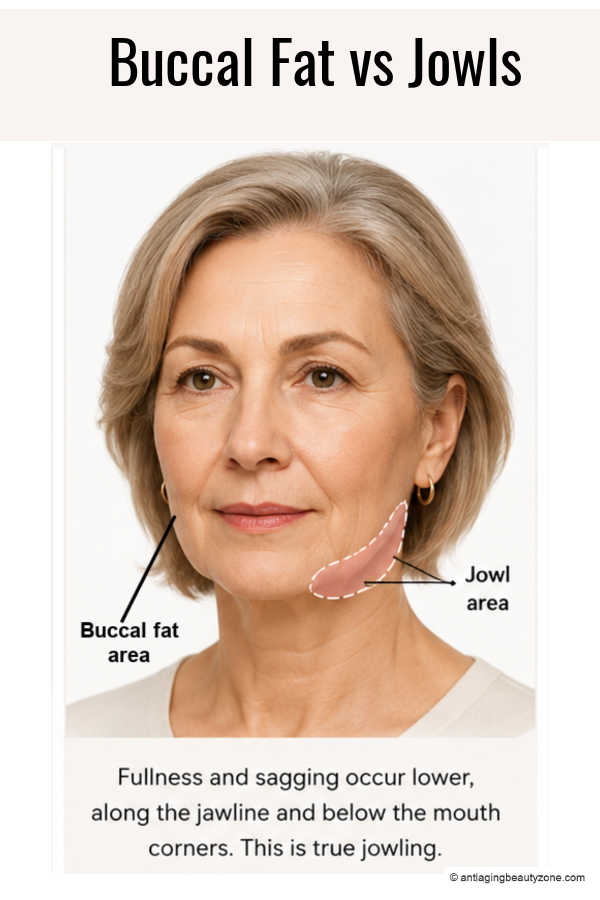
What are buccal fat pads, and where are they located?
Buccal fat pads are pockets of fat located deep inside the lower cheeks, between the cheekbones and jawline and close to the sides of the mouth.
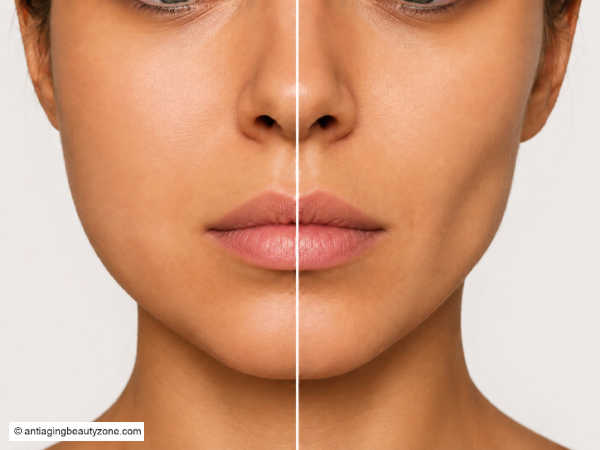 Simulated illustration showing how reducing lower-cheek fullness may change facial contour. Results vary by face shape and the amount of fat removed.
Everyone has them, but their size varies from person to person. Larger buccal fat pads can make the cheeks look fuller or rounder, while smaller pads may create a naturally slimmer or more defined face.
This fullness sits mainly in the cheek area. It is not the same as jowling, which develops lower down along the jawline.
What is buccal fat removal?
Buccal fat removal, sometimes called a bichectomy, is a cosmetic procedure that removes part of the buccal fat pad from each cheek.
The goal is to reduce fullness in the lower cheek area and create a slimmer, more defined appearance. It is not designed to lift loose skin or correct true jowls.
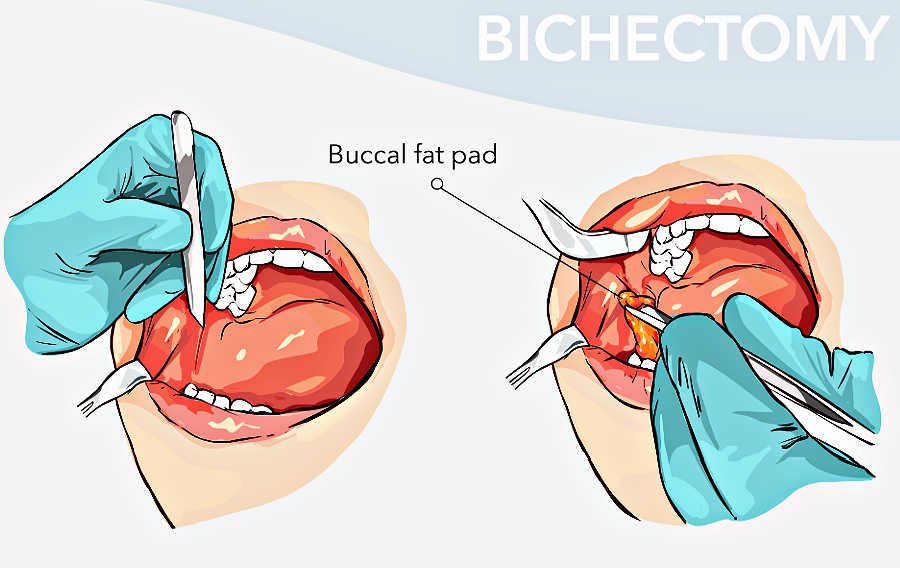 Illustration showing the location of the buccal fat pad inside the cheek.
How is buccal fat removal performed?
A surgeon makes a small incision inside each cheek and removes a portion of the buccal fat pad through the mouth. Because the incisions are inside the cheeks, there are usually no visible scars on the face.
The procedure is often performed with local anesthesia, although the type of anesthesia can vary. Swelling and soreness are common afterward, and healing takes time even though the incisions are small.
What does buccal fat removal actually do?
Buccal fat removal reduces fullness in the lower cheek area. For someone with naturally round or very full cheeks, it may create a slimmer look and make the cheekbones appear more defined.
What it does not do is lift loose skin, tighten the jawline, or correct true jowls.
The result also depends heavily on face shape and how much fat is removed. Taking out too much can leave the cheeks looking hollow or gaunt, especially as the face naturally loses volume with age.
Does buccal fat grow back?
No. Once buccal fat is surgically removed, it does not grow back.
That permanence is one reason this procedure deserves careful thought. Your face will continue to change with age, and weight changes can also affect how full or hollow the cheeks look over time.
For women over 40, the bigger concern is not whether the fat returns. It is whether removing permanent cheek volume now could make the face look more hollow or less supported later.
Does buccal fat removal help jowls?
Not really. Buccal fat removal reduces fullness in the cheeks, while true jowls form lower down along the jawline.
The two can look similar because both may make the lower face appear heavier. But removing cheek fat does not lift loose skin or restore support along the jaw.
In some faces, reducing cheek fullness may make the jawline look a little more defined. But that is not the same as treating sagging jowls, and it may make hollowness or looseness more noticeable if the face is already losing volume.
If you want a lower-risk place to start, my guide to jowl exercises explains what facial exercise may realistically help and what it cannot change.
Buccal fat or jowls: How can you tell the difference?
These two concerns can both make the lower face look fuller, but the fullness usually sits in a different place.
Signs the fullness may be buccal fat
Buccal fat usually shows up as fullness higher on the lower face, rather than sagging along the jawline. Look for these clues:
- The fullness sits mainly in the lower cheeks.
- Your face has looked naturally round or full for many years.
- The area beneath the cheekbones looks soft or padded.
- The fullness is not mainly hanging along the jawline.
Buccal fat removal is intended to reduce this type of cheek fullness. It is not automatically the best choice, especially if your face is already becoming thinner with age.
Signs the fullness may be jowls
Jowls tend to sit lower and are usually connected to changes in skin firmness and facial support. Look for these signs:
- The heaviness sits along or below the jawline.
- The jawline looks less smooth or defined than it used to.
- The skin appears to dip or sag near the corners of the mouth.
- You are also noticing looseness beneath the chin or across the lower face.
Jowls are usually related to changes in skin firmness, facial support, and volume—not simply too much cheek fat. That means removing buccal fat may not improve the real cause.
If you want to see what natural methods can realistically do, take a look at my before-and-after results.
Is it cheek fat, loose skin, or lower-face aging?
Sometimes the answer is not just buccal fat or jowls. Changes in the lower face can come from a combination of cheek volume, looser skin, shifting facial fat, and changes beneath the chin.
Here are a few clues that the issue may be broader than one isolated fat pocket:
- The change appeared gradually rather than being present most of your life.
- You notice looseness along the jaw, chin, or neck as well as the cheeks.
- Your face looks thinner in some places but heavier or softer in others.
- The change became more noticeable after weight loss or with age.
If your face changed after losing weight, that can affect both facial volume and the way the jawline sits. See how weight loss can affect jowls in more detail here.
If the changes extend across the jawline, chin, and neck—not just the cheeks—this page, lower-face sagging breaks down the different areas and what may be contributing.
Why lower-face fullness can be hard to identify
My own face is a good example of why it can be difficult to separate buccal fat from loose skin, shifting facial volume, and normal aging.
In the first photo, taken in my early 50s, my lower face looks softer and fuller. In the second, at about age 63, my cheeks and jawline look more defined—even though I did not have buccal fat removal.
Facial exercise has been part of my routine, but these are not controlled before-and-after photos. Differences in age, weight, lighting, angle, expression, and natural facial changes may all affect how my face looks.
That is why I would be cautious about looking at one area of the face and assuming the problem is simply “too much buccal fat.” Sometimes what looks like cheek fat is really a combination of changing volume, skin laxity, and broader lower-face aging.
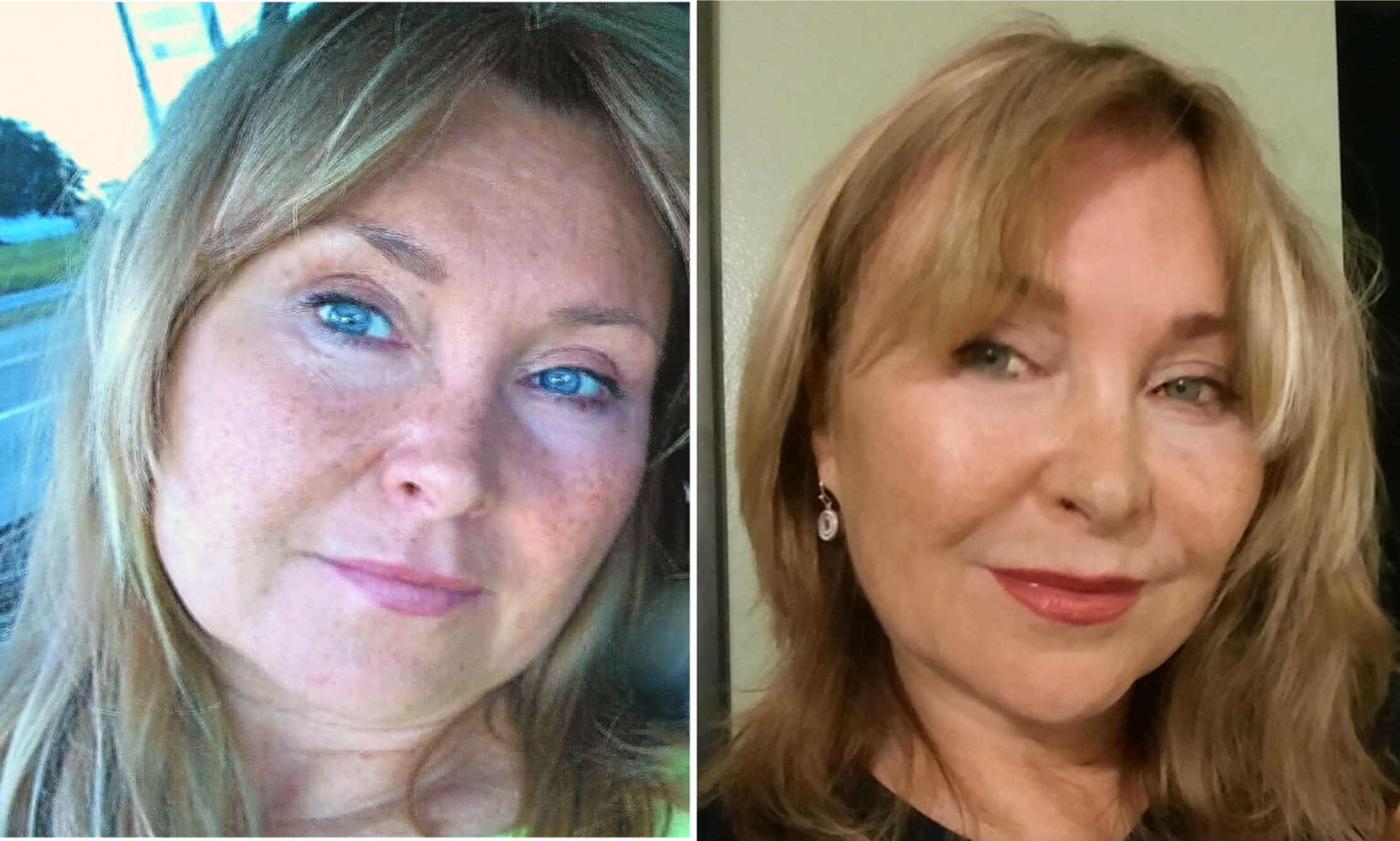 My face in my early 50s and at about age 63. I did not have buccal fat removal. These photos show how facial fullness and contour can change with age, facial exercise, weight, lighting,
I began doing facial exercises after the first photo was taken and continued them over the years. I believe they helped improve the tone and support in my cheeks and lower face, although these photos cannot isolate facial exercise from aging, lighting, expression, and other natural changes.
The important point is that my face became more defined without removing buccal fat. That is one reason I would look carefully at the whole lower face before assuming cheek fullness needs surgery.
Can buccal fat removal make you look older?
This is where buccal fat removal becomes more complicated, especially after 40.
Removing cheek fat may create a slimmer look at first, but the face continues to lose and shift volume with age. A result that looks balanced on a younger, naturally fuller face may look more hollow or drawn years later.
Plastic surgeons do not all view this risk in exactly the same way. Some feel that careful removal in the right candidate can improve cheek contour without noticeably aging the face. Others are more cautious because facial fat contributes to softness and youthful-looking volume.
The American Society of Plastic Surgeons also notes that facial fat is valuable and that overly aggressive removal can create a hollow or prematurely aged appearance.
For a mature face, I would look at the whole picture—not just whether the cheeks seem full today. Existing hollows, thinner skin, weight loss, and early lower-face sagging can all affect how the result may look over time.
Buccal fat removal may make more sense for someone with naturally full cheeks and good skin support. It deserves much more caution when the face is already thinning or losing volume.
What are the risks of buccal fat removal?
Buccal fat removal is often described as a straightforward procedure, but facial plastic surgeon Dr. Gary Linkov notes that the fat pad sits close to important facial structures. That is why the surgeon’s experience and a conservative approach matter.
Structures near the buccal fat pad
The buccal fat pad is located near several important parts of the face and mouth, including:
- the parotid duct, which carries saliva into the mouth
- branches of the facial nerve, which help control facial movement
- blood vessels that supply the surrounding tissues
Because these structures sit close together, removing too much fat or working too aggressively may increase the risk of complications.
Possible side effects and complications
Some swelling, bruising, and soreness are expected during healing. Other possible risks include:
- infection
- bleeding
- unevenness or asymmetry
- injury to nearby nerves or the salivary duct
- prolonged swelling
- an overly hollow or gaunt appearance
- dissatisfaction with the final contour
This is also why buccal fat removal should be evaluated as a whole-face decision, not simply as a way to make the cheeks look smaller.
How much does buccal fat removal cost?
The total price can vary quite a bit depending on the surgeon, location, anesthesia, and where the procedure is performed.
Costs may include:
- the surgeon’s fee
- anesthesia
- the surgical facility or office
- follow-up appointments
- prescriptions or other aftercare expenses
A commonly quoted range is about $2,000 to $5,000 or more, but pricing changes over time and can be higher in some areas.
Because this is usually considered a cosmetic procedure, health insurance generally does not cover it. Ask for a full written estimate so you know what is included before making a decision.
Who may not be a good candidate for buccal fat removal?
Buccal fat removal is not automatically a good fit just because the cheeks look full. The whole face needs to be considered, including existing volume loss, skin support, face shape, and how the face may continue to change with age.
You may need to be especially cautious if:
- your face is naturally thin, narrow, or already hollow beneath the cheekbones
- you have noticeable volume loss in the mid-face
- your main concern is loose skin or sagging along the jawline
- your cheeks became thinner after weight loss
- you are hoping the procedure will lift or tighten true jowls
- you want a dramatic amount of fat removed
People with thin or narrow faces may be more likely to look hollow or gaunt as they age after buccal fat removal. But being over 40 does not automatically rule someone out. A conservative surgeon should consider your natural face shape, skin elasticity, current volume, and likely long-term result—not simply your age.
For me, the most important question is not, “Can this fat be removed?” It is, “How might removing it affect the balance of the whole face five or ten years from now?
If your main concern is sagging rather than naturally full cheeks, check out my before-and-after facial exercise results to see what a non-surgical approach may realistically do.
Takeaway
Buccal fat removal can slim naturally full lower cheeks, but it does not lift loose skin or directly fix true jowls.
For women over 40, the bigger question is how removing permanent cheek volume may affect the whole face over time. If your face is already thinning, hollowing, or sagging, taking out more fat may make those changes more noticeable.
A good consultation should focus on your face shape, existing volume, skin support, and long-term balance—not just whether the fat can be removed.
If your main concern is sagging along the jawline, start with my guide to non-surgical ways to smooth out jowls before considering cheek-fat removal.
FAQ: Buccal fat removal for jowls
Q: Does buccal fat grow back
Q: Does buccal fat grow back
A: No, it does not grow back. So it's important that it's right for your face shape and the surgeon is not too aggressive and remove too much fat.
Q: What surgery removes sagging jowls?
Q: What surgery removes sagging jowls?
A: A facelift is the best surgical choice to improve the visible signs of aging in the lower face and neck, including sagging jowls
Q: How can you reverse sagging jowls?
Q: How can you reverse sagging jowls?
A: Surgical procedures like neck or lower face lifts can tighten the skin and reduce sagging.
Non-surgical options, such as thermage, lasers, and peels, can help tighten the skin a bit.
You could also try jowl exercises as part of a face exercise workout.
Q: Which celebrities had buccal fat removal?
Q: Which celebrities had buccal fat removal?
A: The only celebrity that's admitted to having bichectomy surgery is Chrissy Teigen. However, it's speculated that Lea Michele, Bella Hadid, Zoë Kravitz, Anya Taylor-Joy and Eiza Gonzalez all had this done too.
Q: Why would I regret getting my buccal fat removed?
Q: Why would I regret getting my buccal fat removed?
A: Aside from possible side-effects, it could make you look older. Maybe not when you're young, but later when your natural fat pads thin out.
If you don't have excess buccal fat, removing it could cause you to look older faster. It's best to consult with a plastic surgeon.
Q: What's the price for buccal fat pad removal surgery?
Q: What's the price for buccal fat pad removal surgery?
A: The cost of bichectomy surgery typically ranges from $2,000 to $6,000, with some cases possibly being more expensive. Keep in mind that prices can vary depending on your location.
You might like these
How to Reduce Forehead Wrinkles Naturally (No Botox)
Looking for natural ways to soften forehead wrinkles without Botox? Discover massage, skincare, and at-home tricks to smooth lines and support healthy skin.
Facial Exercises for Cheeks: What Worked for Me for Fuller Cheeks
See the facial exercises I’ve used for years to help my cheeks look fuller and more lifted, plus how I do them and how often I practice.
Facial Muscle Toning: How to Tone Your Face Muscles (What Works)
Can you really tone facial muscles? Yes—here’s how facial muscle toning works, what results to expect, safe starter moves, and how it differs from skin tightening. No gimmicks, just facts.



Have a question or want to share your experience?

I'd love to hear from you! Visit my Questions & Comments page to ask a question, share a tip, or tell me what's worked for you.
You might like these
How to Reduce Puffy Eyes: Causes, Remedies & Treatments
Discover causes of puffy eyes and the best fixes—natural remedies, quick tricks, serums, and medical treatments—in one guide.
Easy Eye Solutions - No Puffy Eyes - Free Shipping - SALE!
Easy Eye Serum for wrinkles, puffiness & crepey - FREE SHIPPING. See my before and after pictures.
7 Under-Eye Serums I Tested for Puffy Eyes (Including Plexaderm)
I tested 7 under-eye serums for puffiness and bags, including Plexaderm and Peter Thomas Roth. See which smoothed best, wore well, and which I’d skip.


Stay Connected with Me
Want to see what I’m up to? I’ll keep you posted on new products I’m trying, little tricks I’ve discovered, new finds, and a few personal updates too.

About the Author:
Linda Robison is a Certified Facial Fitness Specialist and founder of Anti-Aging Beauty Zone, where she shares practical tips, products, techniques, and at-home options for women over 40. She personally tests many of the methods she writes about.
Experience: Linda spent nearly 15 years as an Anti-Aging Health Advisor at the Life Extension Foundation and has over 30 years of experience testing facial anti-aging techniques, including training in Carolyn’s Facial Fitness. Her work has been featured in GB News and Beauty Box Magazine. You can view her background on LinkedIn and follow her on Pinterest.
Found this helpful? Tap the ♡ in the bottom right corner.
FOLLOW OR SAVE

Stay Connected with Me
Want to see what I’m up to? I’ll keep you posted on new products I’m trying, little tricks I’ve discovered, new finds, and a few personal updates too.
Affiliate disclosure: As an Amazon Associate and affiliate for other brands, I may earn a commission from qualifying purchases, at no extra cost to you. [Read Disclosure.] A quick note: I create the content on this site and sometimes use AI tools for writing and images. I review everything for accuracy, and my before-and-after photos are my own.

Anti-Aging Beauty Zone (ABZ): Small Changes, Big Results!
ALL CONTENT COPYRIGHT© 2013-
ALL RIGHTS RESERVED REGARDLESS OF LINKS OR ATTRIBUTIONS
ALL CONTENT COPYRIGHT© 2013-
ALL RIGHTS RESERVED
REGARDLESS OF LINKS OR ATTRIBUTIONS