- Home
- Instant Eye Tighteners
- Why Eye Tighteners Crack
- Why Plexaderm Leaves White Residue
Why Plexaderm Leaves a White Residue (and How to Fix It)

If you’ve ever used Plexaderm and noticed a white, chalky film under your eyes—you’re not imagining it.
I had the same thing happen, especially when I first started using it. One minute it looked smooth, the next it looked dry, flaky, and way more noticeable than the puffiness I was trying to fix.
The good news? It’s usually not the product—it’s how it’s being applied.
Once I figured out what was causing it (and made a few small tweaks), that white residue pretty much disappeared.
In this post, I’ll break down why Plexaderm leaves that white film—and exactly what I do now to keep the under-eye area looking smooth, even with dry skin.

Why Plexaderm leaves a white residue
Plexaderm can leave a white, chalky residue when the tightening film dries unevenly. In my experience, it usually happens when I use too much, apply it before my moisturizer has fully absorbed, or move my under-eye area while it’s setting.
What works best for me is using a very small amount, letting a lightweight moisturizer fully absorb, lightly blotting the area, and then keeping my face still while the Plexaderm sets. If I do get a small white spot, there’s also a simple way I fix it without wiping everything off.
What actually causes the white residue
Using too much is one of the biggest reasons Plexaderm leaves a white residue, but it’s not the only one.
From what I’ve seen, the white film usually shows up when something keeps the tightening layer from drying evenly — too much product, leftover moisturizer, movement while it sets, or very dry under-eye skin.
Using too much product
This is the most common issue, but it’s also easy to misjudge — especially when you’re trying to smooth out puffiness.
Using more doesn’t make Plexaderm work better. It just creates a thicker layer, which is more likely to dry unevenly and show up as a white film.
And if puffiness is still the bigger problem, these other ways to reduce puffy eyes naturally can help.
Moisturizer that hasn’t fully absorbed
This is a big one—and it’s where things can get confusing.
Most instructions say to apply Plexaderm to dry skin, but if your under-eyes are dry (like mine), skipping moisturizer completely doesn’t always look great either.
The problem isn’t moisturizer itself—it’s applying Plexaderm before the moisturizer is fully absorbed.
If there’s still product sitting on the surface, it can interfere with how the tightening layer forms and make the residue more noticeable.
Moving the area while it’s drying
This part is so easy to overlook.
Blinking, smiling, or even talking while it’s setting can disrupt the film before it fully dries. When that happens, it can crack slightly or dry unevenly, which shows up as a white or flaky look.
If you're dealing with cracking or flaking too—not just white residue—I talk more about that here: why instant eye tighteners crack and how to fix it.
Dry skin under-eyes
I’ve noticed this happens more on days when my under-eye area feels drier.
Dry skin can make the product grab unevenly, which makes that white film more visible—even if you’re not using a lot. If dryness or crepey texture is making your tightener harder to use, see how I prep dry, crepey under-eyes before using an instant eye tightener.
Weather and environment
This was something I didn’t realize at first.
On more humid days, it tends to blend in better. On drier days, I’m more likely to see that chalky look if I’m not careful with how I apply it.
How I stopped Plexaderm from leaving that white residue
I had to tweak how I use Plexaderm because my under-eye area is drier now that I’m over 60. Applying it to completely dry skin didn’t work well for me—it made the area look chalky and uneven.
What helped was keeping the skin lightly moisturized, letting that moisturizer fully absorb, blotting off any excess, and then using a very small amount of Plexaderm.
I use a lightweight eye moisturizer first
I don’t skip moisturizer, but I keep it very light.
If I apply Plexaderm to completely dry under-eyes, it tends to grab unevenly and look white and chalky. So I use a lightweight eye cream first—nothing heavy or oily—and only under the eyes.
I let it fully absorb before doing anything else
This part made a big difference for me.
After applying my eye cream, I don’t rush. I give it a good 5 minutes or so to fully sink in. If the moisturizer is still sitting on the skin, Plexaderm is more likely to dry unevenly and look white or chalky.
I’ll usually go brush my teeth or do something else while I wait.
Then I lightly blot the area before applying the serum
After my moisturizer has had time to absorb, I lightly blot under my eyes with a tissue before applying Plexaderm.
This removes any excess moisturizer still sitting on the surface without leaving my under-eye area feeling dry.
This one step made a noticeable difference for me and helped cut down on that white, chalky residue.
I use less than I think I need
This is one of the most important things I’ve learned for avoiding that white residue.
Plexaderm may be labeled “instant,” but it still needs a few minutes—usually 5–10—to fully set. If you add more before it’s finished drying, you can end up with a thicker layer that looks white or chalky.
I use a very small amount, just enough to cover the puffy area. Once I started doing that, I rarely saw that chalky look anymore.
If you’re wondering how long it actually lasts (and how it compares to Peter Thomas Roth), I break that down here: how long Plexaderm lasts vs Peter Thomas Roth.
Note: One thing I noticed is that Peter Thomas Roth doesn’t feel exactly the same as it used to. I compared the original black tube with the newer formula so you can see what changed between the old and new Peter Thomas Roth Instant FIRMx.
If I see residue, I fix it gently (this works best for me)
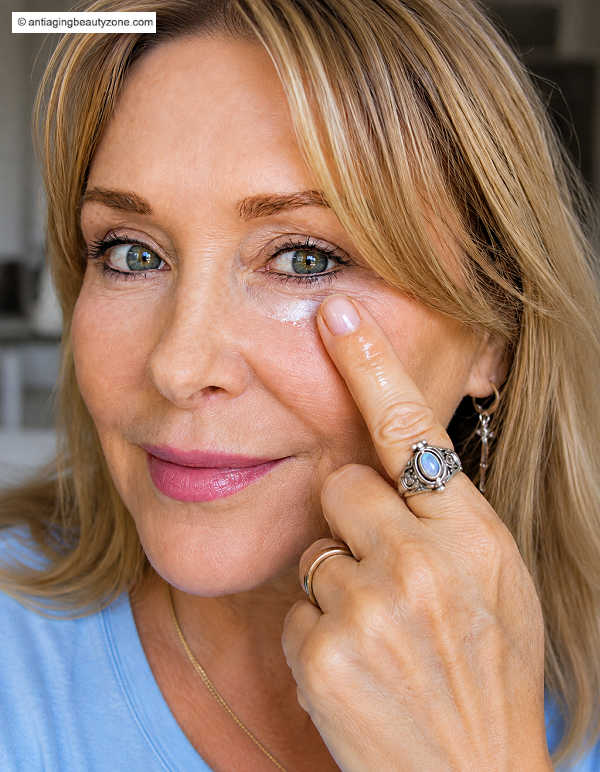 If I see a little white residue, I gently tap just that spot with a slightly damp fingertip instead of wiping the whole area.
On the rare days I notice a little white residue—usually when my under-eyes are drier—I don’t wipe it off with a tissue or Q-tip.
That can remove too much Plexaderm and mess with the tightening effect.
Instead, I slightly dampen my fingertip and gently tap only the white spot or line until it blends in.
That usually fixes it without disturbing the rest of the area.
I’ve noticed it happens more on dry days
I’ve noticed the white residue is more likely to show up when the air is dry. On humid days, Plexaderm tends to look smoother on me, while on drier days I have to be more careful with my prep.
On very dry days, I’ll use a little more moisturizer under my eyes, give it extra time to fully absorb, and then lightly blot before applying Plexaderm. That keeps the area from feeling too dry without leaving excess moisturizer on the surface.
Once I started doing this—using a small amount, letting my moisturizer fully absorb, and blotting first—the white residue issue pretty much disappeared.
Can you use Plexaderm with makeup without getting that white residue?
You can use Plexaderm with makeup, but layering too much over the under-eye area can make the white or chalky look more noticeable.
Personally, I keep makeup off most of the area where I apply Plexaderm. On my outer under-eyes, concealer tends to emphasize fine lines and can make the tightening layer look heavier.
I mainly use concealer at the inner corners where I have discoloration and dark circles, rather than across the whole puffy area.
If you do want to use makeup, keep it light
If you do want to wear makeup over the area, keep it light.
Apply a thin layer and let it set before you apply Plexaderm. If there’s still makeup sitting on the surface, lightly blot the area first.
In my experience, thicker or creamier formulas are more likely to make the white residue show up. Lighter layers are easier to work with.
If you’re trying to make the two work together, I have more tips on using concealer with an instant eye tightener.
Tap—don’t rub
Once your makeup has set and you’ve lightly blotted the area, apply a tiny amount of Plexaderm—about the size of a grain of rice—and gently tap it over the puffy area.
Don’t rub it in. Rubbing can disturb the tightening layer and make it look more visible or uneven.
The lighter the layers underneath, the easier it is for Plexaderm to set smoothly.
If you’ve tried adjusting how you apply it and it’s still not giving you the results you want, it might just not be the best fit for your skin. Maybe some of Plexaderm competitor products might work better for your skin type.
I also compared Plexaderm vs Preparation-H to see how the two products differ for under-eye puffiness and tightening.
Takeaway
That white, chalky residue usually comes down to a few small application changes.
For me, the biggest difference was using less Plexaderm, letting my moisturizer fully absorb, lightly blotting before application, and keeping the area still while it sets.
And if I do see a small white spot, I gently tap just that area with a slightly damp fingertip instead of wiping everything off.
And, if your eyes tend to look swollen or tired in the morning, these quick fixes for puffy eyes may also help before applying makeup or under-eye products.
You might like these
Eyeliner Makeup for Women Over 40: Colors & Tricks to Make Eyes Pop
Eyeliner makeup for older women: learn which colors flatter mature eyes, how to avoid harsh lines, and the best ways to define without aging your look.
How to Reduce Puffy Eyes: Causes, Remedies & Treatments
Discover causes of puffy eyes and the best fixes—natural remedies, quick tricks, serums, and medical treatments—in one guide.
Easy Eye Solutions - No Puffy Eyes - Free Shipping - SALE!
Easy Eye Serum for wrinkles, puffiness & crepey - FREE SHIPPING. See my before and after pictures.


Have a question or want to share your experience?

I'd love to hear from you! Visit my Questions & Comments page to ask a question, share a tip, or tell me what's worked for you.
Stay Connected with Me
Want to see what I’m up to? I’ll keep you posted on new products I’m trying, little tricks I’ve discovered, new finds, and a few personal updates too.

About the Author:
Linda Robison is a Certified Facial Fitness Specialist and founder of Anti-Aging Beauty Zone, where she shares practical tips, products, techniques, and at-home options for women over 40. She personally tests many of the methods she writes about.
Experience: Linda spent nearly 15 years as an Anti-Aging Health Advisor at the Life Extension Foundation and has over 30 years of experience testing facial anti-aging techniques, including training in Carolyn’s Facial Fitness. Her work has been featured in GB News and Beauty Box Magazine. You can view her background on LinkedIn and follow her on Pinterest.
Found this helpful? Tap the ♡ in the bottom right corner.
FOLLOW OR SAVE

Stay Connected with Me
Want to see what I’m up to? I’ll keep you posted on new products I’m trying, little tricks I’ve discovered, new finds, and a few personal updates too.
Affiliate disclosure: As an Amazon Associate and affiliate for other brands, I may earn a commission from qualifying purchases, at no extra cost to you. [Read Disclosure.] A quick note: I create the content on this site and sometimes use AI tools for writing and images. I review everything for accuracy, and my before-and-after photos are my own.
Anti-Aging Beauty Zone (ABZ): Small Changes, Big Results!
ALL CONTENT COPYRIGHT© 2013-
ALL RIGHTS RESERVED REGARDLESS OF LINKS OR ATTRIBUTIONS
ALL CONTENT COPYRIGHT© 2013-
ALL RIGHTS RESERVED
REGARDLESS OF LINKS OR ATTRIBUTIONS