- Home
- Kansa Wand Review
- Kansa Wand Vs. Gua Sha
Kansa Wand vs. Gua Sha: Which Is Better for Your Face?

Trying to decide between a Kansa wand and gua sha? Both are facial massage tools, but they feel quite different on your skin.
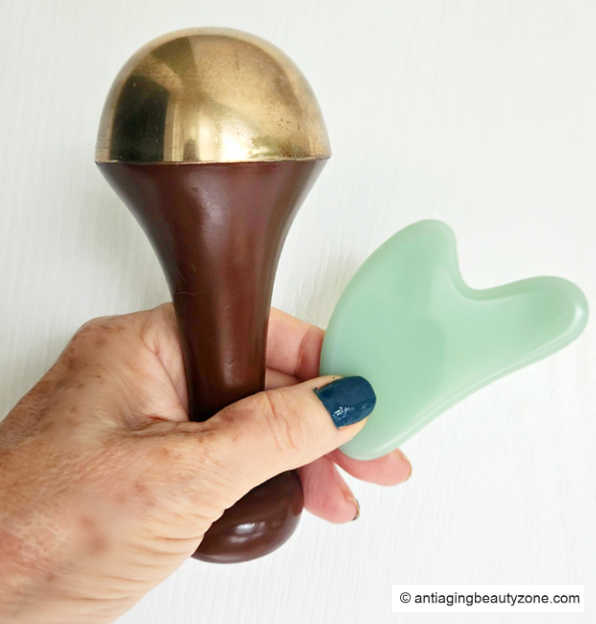 My Kansa wand and gua sha stone. Two different shapes, two different massage experiences.
The Kansa wand has a smooth, rounded metal head that I especially like for massaging tight areas around my jaw and cheeks. Gua sha uses a flat, contoured edge that's better suited to gentle sweeping strokes along the face.
I've used both, and I don't think one is automatically better than the other. It depends on the kind of massage you enjoy and what you're hoping to get from it. I've also shared more about my experience in my Kansa wand review.
Here's how they compare, what I've noticed using them, and which one I'd choose for different needs.
Kansa wand vs. gua sha: Key differences
Both tools give me a stimulating facial massage that leaves my face feeling more awake. But their shapes make a noticeable difference in how they feel and move against my skin.
| Feature | Kansa wand | Gua sha |
|---|---|---|
| Shape | Smooth, rounded metal dome with a handle | Flat stone with curved edges, corners, and V-shaped notches |
| Massage technique | Circular and back-and-forth movements | Gentle scraping or gliding strokes along facial contours |
| How it feels | Focused, rounded pressure against the face | More edge-based contact that follows facial curves |
| Jawline massage | Rounded dome massages over and around the jaw | V-shaped notch can hug the jawbone, contacting areas above and below it |
| Facial puffiness | Can be used for gentle massage over puffy areas | Contoured edges are convenient for long, sweeping strokes used in depuffing massage |
| Ease of use | Handle makes it easy to grip and control | Takes practice to find a comfortable angle and pressure |
| Best suited for | Someone who enjoys focused pressure and circular massage | Someone who prefers a contoured, sweeping massage along the face |
Neither tool has been proven to permanently lift sagging skin or reshape your face. And while both may help temporarily reduce the appearance of puffiness, there's no good evidence that one moves facial fluid more effectively than the other.
Which tool is better for your needs?
For me, the choice comes down to what kind of massage I want that day.
- For tight or tense facial muscles: I prefer the Kansa wand, especially around my forehead, temples, and jaw muscles (the masseters, where we tend to clench our teeth). Its rounded dome lets me apply focused pressure without tiring my fingers. Gua sha can massage these areas, too, but I prefer the feel of the Kansa wand for this.
- For facial puffiness: I usually reach for traditional gua sha. I like how its curved edges follow my face, especially the V-shaped notch that fits around my jawbone. It's convenient for the long, gentle strokes I use when my face looks puffy. If you're new to gua sha, see how I use gua sha on my face.
- For mature or sensitive skin: Either can work if you're gentle. The Kansa wand's rounded surface may feel more comfortable if you dislike the scraping sensation of a gua sha stone. But neither tool should pull, pinch, or irritate your skin. If you're concerned about irritation, see my guide to common gua sha mistakes and how to avoid them.
The biggest difference isn't necessarily what these tools can accomplish. It's how they feel against your face and which type of massage you prefer.
What does research say about gua sha?
I love finding studies that suggest simple, affordable facial massage tools might actually make a difference!
In a small 2025 study, women used either a gua sha-style massage edge or a facial roller for 10 minutes, five days a week, for eight weeks.
Here's something important: The researchers didn't use a traditional gua sha stone like mine. They used a combination massage device with rollers on one side and a curved edge for gua sha massage on the other.
Still, the findings were interesting.
After eight weeks, both groups had small reductions in facial measurements, including around the jawline. These changes suggest their facial contours may have become slightly more defined.
The gua sha group also had less facial muscle stiffness, while the roller group showed measurable improvements in skin elasticity.
I find that encouraging! But the study was small, involved women ages 20–50, and didn't test traditional gua sha stones or Kansa wands. We also don't know whether the changes last after stopping the massages.
So while this research suggests facial massage may have benefits beyond simply feeling good, we can't assume the same results from the tools I'm comparing here.
Read the 2025 study in the Journal of Cosmetic Dermatology.
Do you need both a Kansa wand and gua sha?
You may not need both, but I personally find them useful for different types of facial massage.
I like the Kansa wand for a broader, deeper-feeling facial massage. Its rounded dome and comfortable handle make it easy to massage larger areas without tiring my hands. I can even use it while watching TV, without concentrating on every movement.
Gua sha is more of a targeted massage for me. Its firm stone edges, curves, and pointed ends let me work more precisely around my jawline, chin, and under-eye area. The V-shaped notch is especially handy for following the curves of my chin and jawbone.
I prefer using gua sha in front of a mirror so I can see how the stone fits against my face and give a little extra attention to areas I want to massage. It takes more concentration than the Kansa wand, but I like that precision.
For me, having both is worthwhile. I use the Kansa wand when I want an easy, all-over massage and gua sha when I want to focus on specific areas. But if you're happy with the tool you already own, there's no need to buy another just because it's popular.
What about electric gua sha?
There's another option I've been using: a heated, vibrating gua sha device from Carolyn's Facial Fitness.
This one is a bit different from a traditional gua sha stone. It combines the contoured massage edge with heat and vibration, which I absolutely love! The massage feels wonderful, and it's often what I reach for when my face looks tired or puffy.
The device also includes red light and is advertised as having microcurrent. While Carolyn makes additional claims about firming and improving skin appearance, I can't say how much those features contribute to the results I notice.
You can see how I use it in my review of the CFF heated gua sha tool.
If you're interested in other ways to massage your face, including techniques you can do with your hands, see my at-home face lift massage guide.
Have a question or want to share your experience?

I'd love to hear from you! Visit my Questions & Comments page to ask a question, share a tip, or tell me what's worked for you.
Want to Stay in Touch?
Get my latest beauty tips, products I'm trying, little tricks I've discovered, and a few personal updates, too.
I'd love to keep you in the loop!

About the Author:
Linda Robison is a Certified Facial Fitness Specialist and founder of Anti-Aging Beauty Zone, where she shares practical tips, products, techniques, and at-home options for women over 40. She personally tests many of the methods she writes about.
Experience: Linda spent nearly 15 years as an Anti-Aging Health Advisor at the Life Extension Foundation and has over 30 years of experience testing facial anti-aging techniques, including training in Carolyn’s Facial Fitness. Her work has been featured in GB News and Beauty Box Magazine. You can view her background on LinkedIn and follow her on Pinterest.
Found this helpful? Tap the ♡ in the bottom right corner.
FOLLOW OR SAVE

Stay Connected with Me
Want to see what I’m up to? I’ll keep you posted on new products I’m trying, little tricks I’ve discovered, new finds, and a few personal updates too.
Affiliate disclosure: As an Amazon Associate and affiliate for other brands, I may earn a commission from qualifying purchases, at no extra cost to you. [Read Disclosure.] A quick note: I create the content on this site and sometimes use AI tools for writing and images. I review everything for accuracy, and my before-and-after photos are my own.

Anti-Aging Beauty Zone (ABZ): Small Changes, Big Results!
ALL CONTENT COPYRIGHT© 2013-
ALL RIGHTS RESERVED REGARDLESS OF LINKS OR ATTRIBUTIONS
ALL CONTENT COPYRIGHT© 2013-
ALL RIGHTS RESERVED
REGARDLESS OF LINKS OR ATTRIBUTIONS